How to become a Full Stack Journalist?

In the opening session, Nic Newman summed up 15 years of “product” in just seven minutes. Twenty-five years ago, tech was still a marginal presence in newsrooms. In the history of “product” — a term that remains vague for many journalists (Nic Newman cites a Reuters Institute survey: 93% of newsrooms consider the topic important, but only 45% feel they truly understand what it involves) — the launch of the iPlayer was a turning point. It went online on Christmas Day 2007, after three years of failed attempts, marking the introduction of the “agile method” into the media world.
Today, usage data makes it possible to move from a minimum viable product to a minimum viable experience. This is no longer a technological challenge, but a business one.
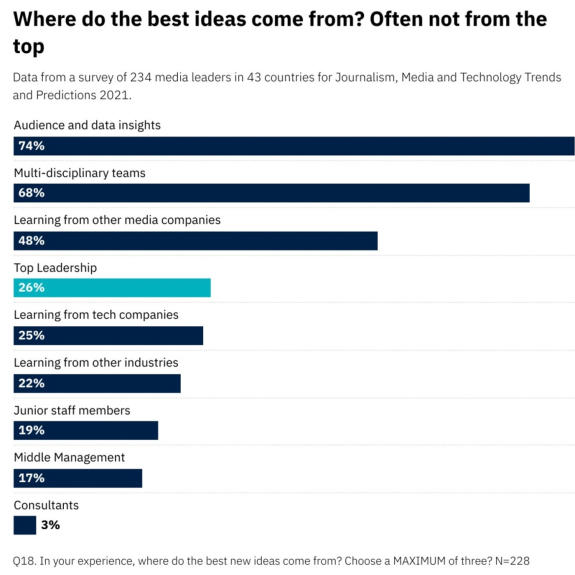
Within the decision-making chain, power and budgets often remain concentrated on the editorial side. It might be time to also experiment with a minimum viable structure. On a positive note: product is no longer a trend, but a strategic position. A growth lever. And the best ideas do not necessarily come from top management…
If we define product as a “value exchange with the audience,” then how can we define — and more importantly, measure — that value? This is exactly what the panel “The Public Value of Journalism: Between Individual Metrics and Societal Impact” set out to explore, bringing together Smartocto (which tracks all individual-level metrics), Mattia Peretti (founder of News Alchemists), and Karlijn Goossen from 360 NPO. All three question the gap between what is measured on a daily basis and what truly motivates a journalist to get out of bed in the morning — in other words, societal value.
Is the User Needs Model (created by Dmitry Shishkin) more relevant in its 2.0 version with Smartocto? Are we perhaps looking at the wrong numbers, in the wrong way? Is the real question not rather: what happens in the world if we are no longer here tomorrow? We are over-indexing the how, without questioning the why enough.
We should be moving toward a more relational rather than transactional model. But how can we balance the demonstration of social value with that of individual value, in a society so focused on the self (the audience question)?
For Upasna Gautam, Senior Platform Product Manager at CNN, “trust is a byproduct of curiosity.” She introduces the notion of the Full Stack Journalist, borrowed from product vocabulary: content is the product, and every journalist should understand both how it is created and how it is distributed.
The gatekeeper role is definitively over. To remain relevant, media organisations must rethink their function. Without going as far as the “therapist” role — mentioned in several panels — the focus should be on listening more closely to audience needs. Even when the findings are uncomfortable, as with the News for All study that the BBC hesitated to publish for a long time, fearing the results were too confrontational.
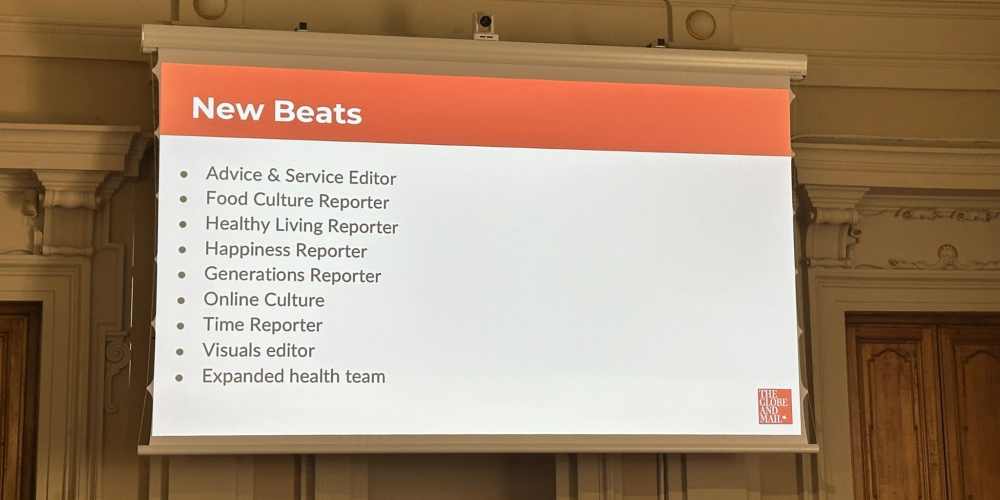
The Globe and Mail in Canada completely reorganised its newsroom after realising that too many journalists were covering the same types of stories. A structural overhaul designed to rebalance editorial resources.
Like many speakers, Ellen Heinrichs, founder of the Bonn Institute, urges newsrooms to stop chasing the latest AI gadget. It would be better to invest in resolutely human journalism. Audiences are not asking for a sophisticated chatbot that speaks their language, but for journalists on the ground, in their neighbourhoods, who know how to listen. A form of journalism as a service, which Ellen Heinrichs breaks down into three key principles:
Solutions — not as a format, but as a principle of editorial leadership
Perspectives — telling a story through someone else’s eyes
Dialogue — to move beyond the binary logic of for/against and introduce nuance.


