A puzzle a day keeps the audience: how daily games can be a retention strategy for media organisations

How do you create habits, strengthen audience loyalty and encourage users to explore more content across your platform? From The New York Times to Finland and even Belgium, media organisations are increasingly experimenting with games and puzzles to engage their audiences. Two media organisations are a great example of this trend. Yle does so with its Word Pyramid game, while VRT’s children channel Ketnet is experimenting with a summer-long treasure hunt that encourages young users to return to VRT MAX every day.
By integrating games into their platforms, these organisations create a daily habit: users have a reason to come back, discover new content and engage with the platform on a regular basis.
Yle’s ‘Word Pyramid’ game
To build a daily relationship with their adult audience, Finnish public broadcaster Yle build the Word Pyramid game. The idea emerged in late 2024, when Yle noticed that many popular word-grouping games were only available in English. Inspired by games such as The New York Times Connections, the team explored whether a similar concept could work in Finnish. Yle wanted a product that would drive regular traffic to its platform, encourage users to explore other content and create a rewarding daily ritual. To avoid endless play sessions, the game was limited to a single puzzle per day, helping to build a habit of returning. Each puzzle consists of 15 words that players must sort into groups of five, four, three and two related words, leaving one word unused at the top of the pyramid. The challenge lies in identifying the hidden connections between the words, which can range from cultural references and categories to word meanings and associations. This active participation transformed the audience from players into contributors, further strengthening engagement with the platform. Word Pyramid players read around 28% more articles. This confirms that the game is acting as a gateway to other content.
Think you can crack the pyramid? Try the example below and see if you can spot the connections.
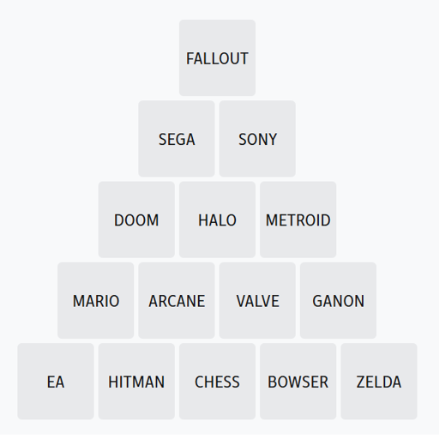
Yle also discovered that creating puzzles was almost as engaging as solving them. What started as a game for players evolved into a participatory format, with thousands of users submitting their own pyramids. Al lot of those puzzles were eventually published. One of the most surprising findings was the social dimension of the game. Although Word Pyramid is designed as a single-player experience, many users solve puzzles together with family members, friends, or colleagues through WhatsApp groups, creating a community feeling. Lastly, the educative aspect seems stronger than expected. Users frequently searched for unfamiliar terms, in that way the game helps them discover new knowledge.
Different audience, same objective
Although Yle focuses on adults and news consumers, we see the same approach at Ketnet. In the summer of 2026, the Flemish children’s channel launched the ‘Zotte Zomer zoektocht’ (crazy summer treasure hunt), a series of daily challenges designed to encourage children to keep coming back to VRT’s streaming platform VRT MAX.
The mechanics behind the ‘Zotte Zomer zoektocht’ are relatively simple, yet effective. Every day, a new challenge appears in the game's dedicated community feed on VRT MAX. Rather than solving a puzzle directly, children are encouraged to go on a digital scavenger hunt across the wider Ketnet ecosystem. Clues can be hidden almost anywhere: in the set of a programme such as Hallo Kroket (a popular children’s programme in Flanders), in soundboards on the games page, in rebuses, morse codes or other pieces of Ketnet content. By completing each daily challenge, players gradually collect fragments of a word or sentence. At the end of the week, after receiving the final clue on Friday, they can submit their solution through a competition form. That way, they can win a prize, such as a beach towel. The format encourages children not only to return every day, but also to actively explore different parts of the platform. Children don’t just come for the games; they are automatically exposed to videos, kids programmes and other interactive content.
Between July 1st and August 26th, 2026, the dedicated ‘Zotte Zomer zoektocht’ feed generated over 21,000 pageviews. The results also show that there is still room for growth. Awareness can play a role, but so can the timing of the launch. Summer is typically a quieter period for Ketnet, with fewer people watching and playing.
The community feed also adds a social layer to the experience. Besides serving as the place where daily challenges are published, the feed allows children to discuss clues, help each other solve puzzles and interact with fellow players to find solutions together. This social layer transforms the game into a shared experience and gives users an additional reason to return to VRT MAX every day.
Why does gamification works so well?
People take pleasure in solving challenges, monitoring their progress and experiencing a sense of accomplishment. When presented as bite-sized daily tasks, these mechanics encourage repeat visits and help establish lasting user habits. The success of initiatives such as Yle's Word Pyramid and Ketnet's ‘Zotte Zomer zoektocht’ can partly be explained by the so-called "Duolingo effect": using gamification to turn occasional users into daily visitors. Through small challenges, visible progress and recurring rewards, platforms encourage audiences to develop a habit of returning every day.
Anticipation is also created by daily games. Platforms give users a reason to return, rather than finish everything all at once by restricting the experience to one puzzle or challenge each day.
The social component is another crucial component. Even single-player games frequently develop into shared experiences as players discuss solutions, compare scores and assist one another in overcoming obstacles. This fosters a feeling of community and increases engagement.
Take-aways
Although the two games target very different audiences, they offer several valuable lessons for media organisations looking to strengthen engagement and retention.
Some take-aways:
- Create a reason to return every day. Both Yle and Ketnet focus on building habits, rather than attracting one-time visitors.
- Games should lead users to other content. The game itself is not the end goal, but a gateway to the wider platform.
- Community increases engagement. Whether through WhatsApp groups or a dedicated chat feed, users enjoy solving challenges together.
- Adapt the format to your audience. A word puzzle works for adults, while a quest-based challenge resonates with children, but the underlying strategy remains the same.
Yle and Ketnet show that the future of audience engagement may not necessarily lie in producing more content, but in creating reasons to return. While one of them built a daily word puzzle for adults and the other designed a holiday quest for children, both are solving the same problem: habit formation. In an era of endless competition for attention, a daily challenge might be one of the simplest ways to turn occasional visitors into loyal users.


