Shaping the Future of Media Together: Future Media Hubs at IBC 2026

What does innovation in media look like today, and where is it heading next?
At IBC 2026, Future Media Hubs brought together media organisations, researchers and technology innovators at the EBU booth for an afternoon of presentations and discussions around some of the key developments shaping the future of our industry.
The first session dived deeper into how AI is changing both the technology infrastructure behind media and the way content is produced, while also considering what this means for public media organisations. Loïc De Visscher (Corporate Innovation Manager, RTBF) talked about sovereign AI capabilities in public media. The key message is that building AI infrastructure goes far beyond simply acquiring GPUs: the real challenge lies in operating them effectively at scale. AI sovereignty also requires organisations to define their own quality standards and continuously test their systems against those standards. Finally, governance should not be seen as an administrative burden, but as an essential enabler for bringing AI use cases onto the platform in a safe, controlled and effective way.
But technological innovation is only one part of the equation. Matthias Van Turennout (Strategy Manager, EO) explored the growing importance of community building in an age of AI. As content creation and distribution become increasingly accessible, they are no longer scarce resources. This fundamentally changes the role of public service media, shifting its focus towards building and strengthening communities. However, a truly radical shift requires more than a change in strategy: it needs to be reflected in resource allocation, with more than 50% of the budget directed towards the new priorities.
Steven Oldengarm (Senior Online Strategist, NPO) brought a practical perspective through the learnings from the FOMO Show (developed and created by KRO-NCRV and CCCP for the NPO's YouTube channel) , demonstrating how experimentation with new formats can provide valuable insights into changing audience behaviour. The main takeaway is that NPO uses YouTube strategically as a discovery and community-building channel, rather than treating it as the final destination for its content. The FOMO show leverages YouTube’s large reach to attract audiences and then creates a bridge towards NPO’s own platform, where it can build a deeper and more direct relationship with viewers.
The sessions also offered a glimpse into how emerging technologies could fundamentally change the way audiences experience media. Jeroen Cluckers (Creative research lead Immersive Lab, AP) presented PAIC (Portable AI-Camera), showcasing real-time AI-driven image transformation. PAIC makes real-time generative video controllable, allowing creators to adjust subjects and backgrounds independently. This shortens the path from creative concept to usable video, with live experiences as the first market and virtual production as the next. Bert Ramlot (PhD researcher, IDLab-Media at Ghent University & imec) explored 3D Gaussian Splatting and volumetric video and their potential for creating new forms of immersive content. Volumetric video has matured beyond the research stage and is now ready for its first real-world applications. Gaussian Splatting forms the technological backbone, while ongoing research continues to address challenges in capturing, storing, transmitting, and rendering volumetric content.
At the same time, audience interaction with media is also undergoing significant change. Luk Overmeire (Innovation projects and partnerships coordinator, VRT) presented Narrate and explored the potential of conversational storytelling, pointing towards a future where audiences may interact with stories and media content in fundamentally different ways. The desired experience of Narrate is not limited to a single interface or interaction pattern. Instead, a new storytelling and interaction model is needed, giving users multiple ways to control and engage with the experience.
Following the presentations from our members, we also welcomed two promising startups to the programme, who presented their innovations at the EBU booth. HappyClient, represented by Mathias Teuwen (Full-Stack Video & Marketing Product Engineer), demonstrated how AI can turn audience interaction from a potential disruption into an integral part of the broadcast. By automating the collection, filtering and editing of viewer questions, AI enables broadcasters to seamlessly integrate audience contributions directly into live content. Nick Elmqvist (CEO and Co-Founder) from SureShot explored the growing potential of user-generated content (UGC) for media organisations. The session covered how broadcasters can access rights-cleared content from events, the volume and variety they can expect, and how UGC can enhance live coverage, social media and other editorial formats. 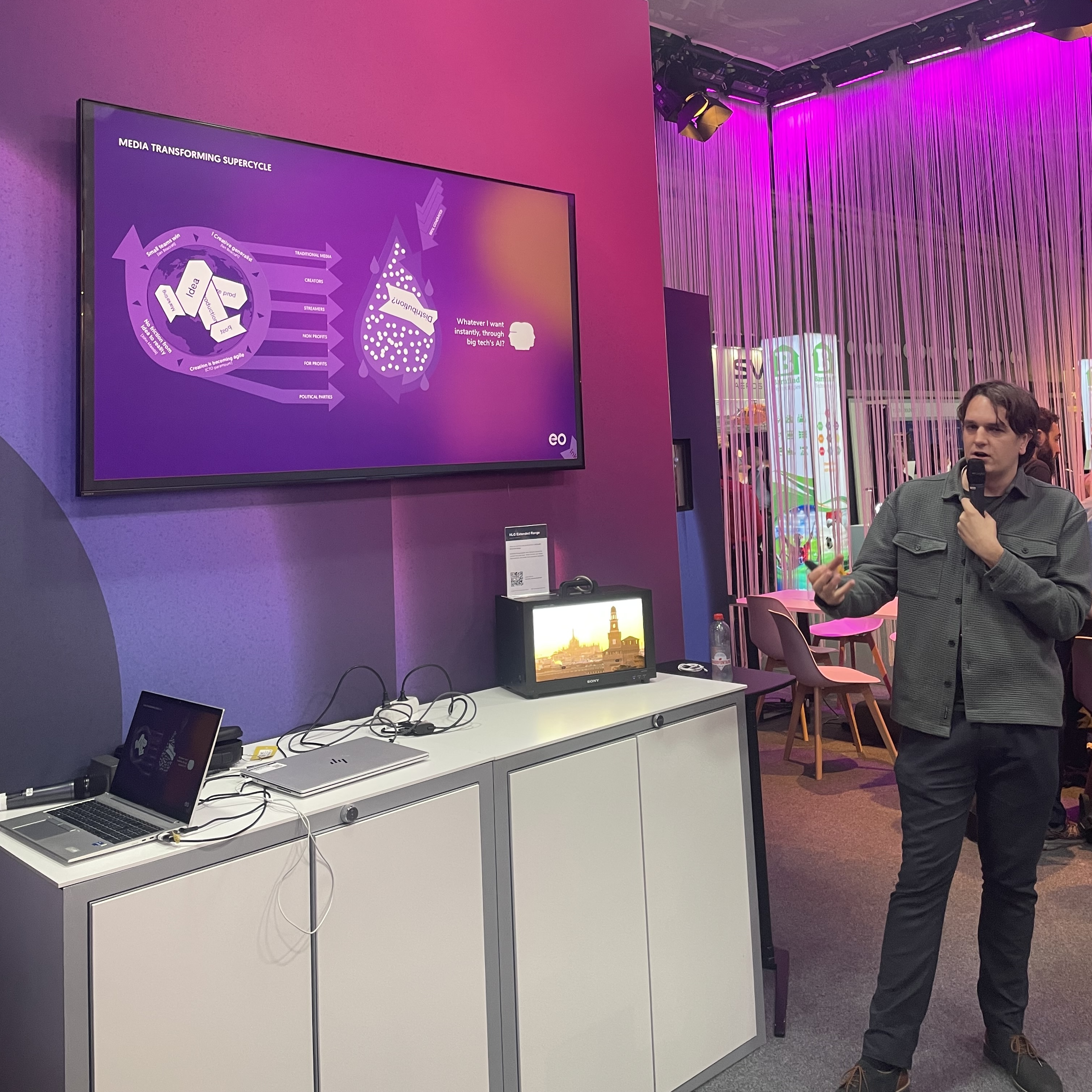
Conclusion
The sessions at IBC 2026 highlighted several concrete directions for the future of media:
- Building sovereign AI capabilities;
- Strengthening communities;
- Experimenting with new formats;
- Developing immersive and conversational experiences; and
- Finding new ways to integrate audience-generated content.
From AI infrastructure and real-time generative video to volumetric media and UGC, the presentations showed how these technologies are moving from experimentation towards practical applications. Together, they offered a glimpse into how media creation, distribution and audience engagement could evolve in the years ahead.


