What if news didn’t leave people exhausted?

People often assume that declining news consumption means audiences no longer care about what is happening in the world. Yet, the reality is more complicated. Many people still want to stay informed but feel overwhelmed by the way news is presented. Constant updates, conflict-driven coverage and attention-grabbing headlines can leave audiences feeling exhausted, rather than engaged.
For Ingrid Tinmannsvik, co-founder of the Norwegian news initiative DEMO, this became the starting point for a bigger question: what if the problem is not that people have lost interest in news, but that they have grown tired of the news experience itself?
Looking beyond constructive journalism
Before starting DEMO, Ingrid spent years working with constructive journalism at NRK. The approach focused on reporting problems, while also exploring responses and possible ways forward. The results were promising: constructive stories reached younger audiences, generated strong engagement and accumulated millions of page views. Yet, despite these successes, a broader challenge remained. News avoidance continued to grow and many people still described the news as something that left them frustrated, powerless or drained.
Rather than assuming they knew the answer, the DEMO team decided to ask people directly what they felt was missing from today's news.
Listening before building
Rather than immediately launching a new platform, the DEMO team started by listening. Through hundreds of conversations and interviews with people across Norway, they set out to understand how audiences experienced the current media landscape and what they felt was missing.
The same frustrations surfaced again and again. Participants spoke about information overload, sensational headlines and a constant focus on conflict. Many felt they were receiving fragments of information without enough context to understand how developments connected to one another.
At the same time, these conversations revealed something important: people were not asking for less journalism. They were asking for journalism that helped them make sense of the world. Many wanted deeper reporting, broader perspectives and stories that explained why developments mattered, rather than simply reporting that they had happened. They were looking for content that informed, without adding to the noise.
One future founding member summarised that need perfectly:
Building a different kind of news medium
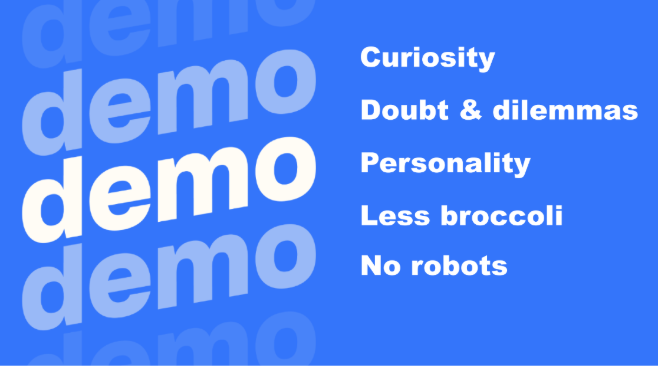
Those insights became the foundation for DEMO. The ambition is not to compete on speed or to win the race for the latest update. Instead, the platform is built around depth, curiosity and understanding. DEMO describes itself as a place where important issues are explored in greater detail and where stories help readers understand how different developments connect to one another.
This philosophy extends beyond the editorial approach. From the beginning, DEMO was developed through conversations with people across Norway. These conversations were not treated as a separate research exercise, but as part of the development process. Rather than deciding internally what people should want from a news organisation, the team started by asking what kind of journalism people felt was missing from their lives.
Once the concept had taken shape, DEMO invited people to become founding members by purchasing a one-year membership before the platform officially launched. More than 5,000 people signed up, giving the team the financial foundation to launch an advertising-free publication. Beyond making the launch possible, the response also suggested that the ideas developed during the listening phase resonated with a broader audience.
The campaign also revealed something beyond financial support. Many founding members shared their founding member certificates on social media and engaged with the project before any journalism had been published. This created an early sense of community around DEMO and suggests that people were responding to the prospect of future content as well as the opportunity to help build a different kind of news medium.
More than reporting the news
The vision behind DEMO is not simply to produce journalism differently, but to create a different relationship with journalism altogether. Instead of focusing primarily on what happened today, the platform aims to provide stories that people genuinely look forward to reading, even when the topics themselves are complex or serious.
The goal is to create journalism that leaves audiences feeling better informed and more capable of understanding the world around them, rather than feeling overwhelmed by it. In that sense, DEMO is not only rethinking content, but also reconsidering the role a news organisation can play in people's lives.
What media companies can take from this
DEMO offers several lessons for media organisations facing similar challenges around engagement, trust and news avoidance.
News avoidance is not the same as news indifference
People who consume less news are not necessarily less interested in public affairs. Disengagement is often linked to how news is experienced, rather than a lack of interest in staying informed. For media organisations, this means that increasing reach is not always the same as increasing relevance.
Listening can be part of product development
Instead of treating audience research as a separate exercise, DEMO used conversations with people across Norway to shape the editorial direction of the platform itself. This shows how audience input can shape editorial choices, product positioning and even the purpose of a media product.
Context can be as valuable as speed
Many of the people DEMO spoke to were not asking for faster updates or more content. They were looking for journalism that helped them understand how developments connect to one another and why they matter. In an environment where audiences are constantly exposed to headlines and notifications, context and perspective can become a key differentiator.
The news experience matters
The DEMO project highlights that engagement is shaped by both the stories being told and the way audiences experience them. If journalism consistently leaves people feeling overwhelmed or powerless, they may disengage even when they still care about the issues being covered. Rethinking the overall news experience can therefore be just as important as experimenting with new formats or platforms.
Looking ahead
While DEMO is rooted in the Norwegian media landscape, the questions it raises extend far beyond Norway. News avoidance, declining trust and audience fatigue are challenges faced by media organisations around the world. The project is testing a new publication while exploring whether there is demand for a different relationship with news.
Article written by Marie Sommen, with the input of Ingrid Tinmannsvik (DEMO)


