Two strategies for broadcasters to reach youngsters

"CNN, NPR & The Washington Post look much more similar today than they did three decades ago"
Schulz, et al. (2020): Mediated Millenials.
At the same time the general attention span is increasingly lower than it was twenty years ago. It has decreased because of the supply of digital content. Generation Z’s attention span is short, and they live in an 8-second world where they are looking for “snackable” information and pictures in an integrated cross-channel experience. Digital feeds are personalized to different users and digital natives can choose their inputs on a bigger scale. In a research article of 2005, Scannel states that the personalized media use provided by digitalization is a huge threat to traditional broadcasting. In the last few years, there has also been a change in the mindsets of journalists. When creating content for digital consumption, media houses are competing with thousands of other actors in getting the attention of their target group.
GEN Z: So hard to get
The idea that young people form a distinct media generation, with (radically) different media use patterns and preferences than before, is well established in academic literature as well as in popular discourse, and also largely framed as a potential problem for legacy media.
Young people are important target groups for legacy media since they, as future audiences, are vital for both the commercial survival of the media and a well-functioning public sphere. Often seen as a new media generation, the so-called digital and global natives have distinct media habits and preferences and are hard to reach, making them sometimes even a ‘lost generation’ for legacy media. It has become increasingly harder to get attention from consumers when using traditional and digital media platforms in the “age of freedom of choice”, which is why legacy media companies & broadcasters maybe should redefine their target groups and where they go for reaching them. In this article, I will present two possible strategies for how legacy media companies could work with distributing their content to this generation and how these strategies are affecting the aim of building trustable relationships with their users.
Last year I made a research paper that discusses two narratives for how legacy media companies are responding to the real or imagined challenge of reaching young people in the age of digitalization, by investigating two different strategies for how to make use of the so-called ‘Generation Z’ preference for sensory and visual journalism. Through qualitative expert interviews, this study presents how the Norwegian public broadcaster NRK P3 and the biggest newspaper in Norway, VG, are approaching the challenge of catching young people’s attention. We identify two narratives, or strategies, for how legacy media companies work with visual expressions and design their digital content when trying to reach a wide, fragmented young target group on digital platforms.
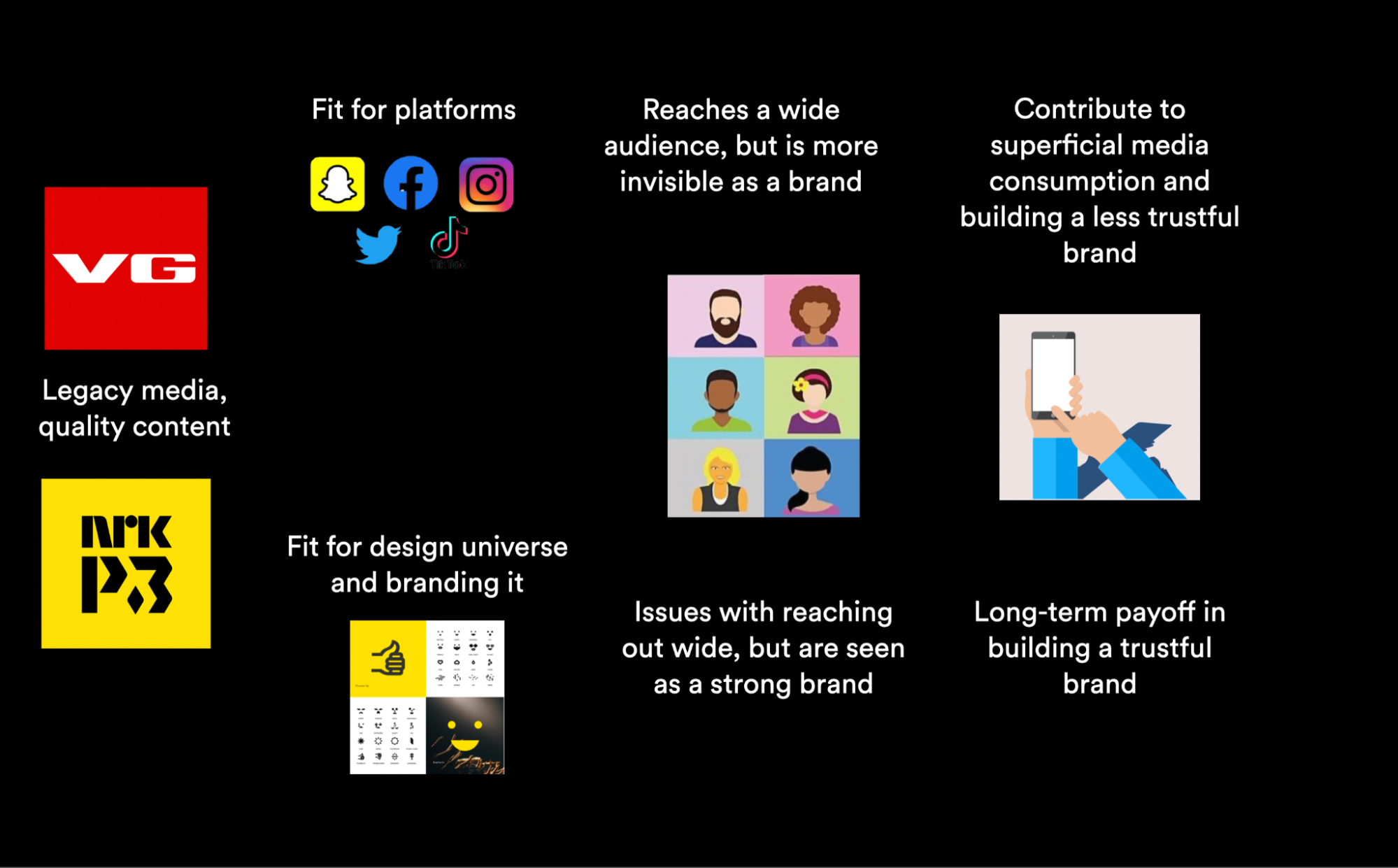
- VG is a platform-oriented storyteller where design is connected to the direction and mode of storytelling and tailored to fit certain platforms. Their area of focus is being where their target groups are and meeting the visual expectations of these audiences by taking cues from what's trending on different platforms.
- NRK P3 takes the approach of a traditional brander that works in both visionary and traditional ways to build a strong, trustworthy, and highly visible brand. Ensuring that their content has a recognizable look is a main priority for NRK P3 and they emphasize building a brand without the use of various third-party platforms. We conclude by pointing out possible problems with both these approaches.
Two strategies for content-distribution to GEN Z
We identify two narratives, or strategies, for how legacy media companies work with visual expressions and design their digital content when trying to reach out to a wide, fragmented young target group on digital platforms.
- Be a platform-oriented storyteller
In our research we name VG a platform-oriented storyteller. It's a strategy where you communicate and interact with your audience across multiple platforms. It’s a strategy where you don't necessarily aim to convert readers home to your homecourt, but you want to be visible with your brand and tell stories using the most optimal platform for reaching out to this or that specific target group. Design is connected to the direction and design of storytelling and fit for platforms. Their area of focus is by being where their target groups are and meeting their visual expectations by following what's trending on different platforms. - Fit your content for your design universe and brand it-strategy.
NRK P3 takes the approach of a traditional brander that works visionary and traditional to build a strong, trustful, and visible brand. Ensuring that their content looks recognizable is a high priority for NRK P3 and they prioritize building a brand without a wide use of different third-party platforms.
Which strategy do I choose for reaching my young audience?
Both VG and P3 are doing good in their design and aesthetic-related choices for reaching out to their audience, but we would argue that both approaches have potential pitfalls.
A wide use of different social media platforms is highly beneficial when reaching out to a bigger amount of people, but at the same time, the content published on these channels is meeting issues connected to lower attention span and superficial calls of interaction which may contribute in creating lower quality content.
The “News-finds-me” mindset where people are involuntarily stumbling over the news, has become the dominant mode of news acquisition. A study by Curran, et al. in 2014 concluded that 37% of young adults between 18 and 34 years do not seek information on a regular basis. VG’s strategy of being present on the platforms where their consumers are, is clearly a response designed to meet those trends. On the other hand we concern that VG is getting a short-term advantage in reaching out to its audience and recruiting new ones for being flexible in testing formats and storytelling. In a longer time of period, this attitude might affect them negatively considering being seen as a trustful brand. This is because trust is highly connected to the way we perceive and receive a message. In our comprehensive literature review, we discuss the issues that arise when artistic trends come into journalism. It signifies a retreat from traditional professional standards and some journalistic practices are connected to the aestheticization of the ugly, which is highly connected to modern aesthetic trends. Underneath is an example from a story on Snapchat where VG is telling a story about sharks coming into the Norwegian fjords.
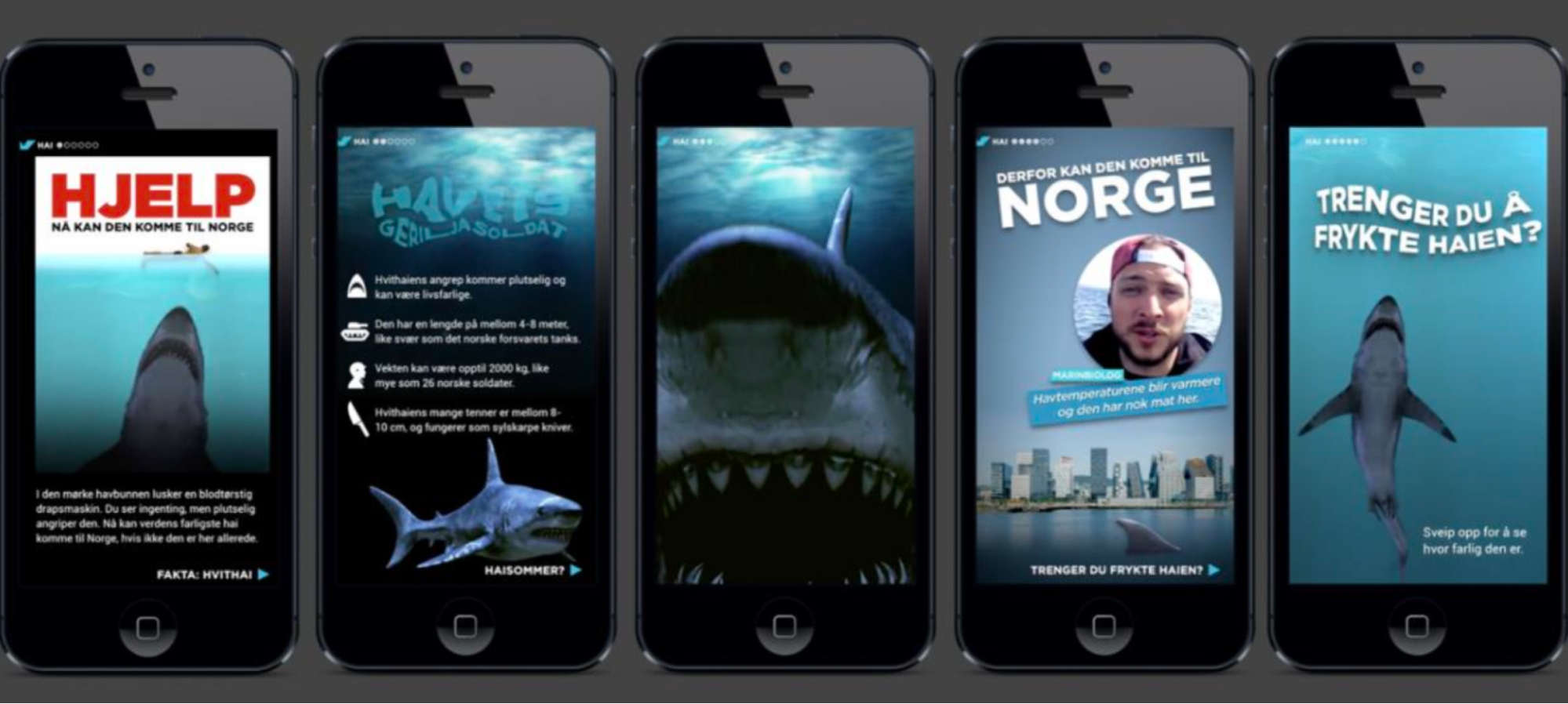
This example is highly influenced by popular culture and the universe of Jaws, Finding Nemo, etc. We are concerned that the issue with building trust occurs when the target groups no longer see the difference between legacy media content and other content. When legacy media aim to follow aesthetic trends for hitting a wide audience, they get invisible because the target group sees them as something else and not necessarily as news. In journalism, conventions of representation are seen as reality itself. In the example below you can see how we throughout decades have presented “the reality itself” versus how new elements from outside these traditional professional standards are affecting the way we try to present the reality.
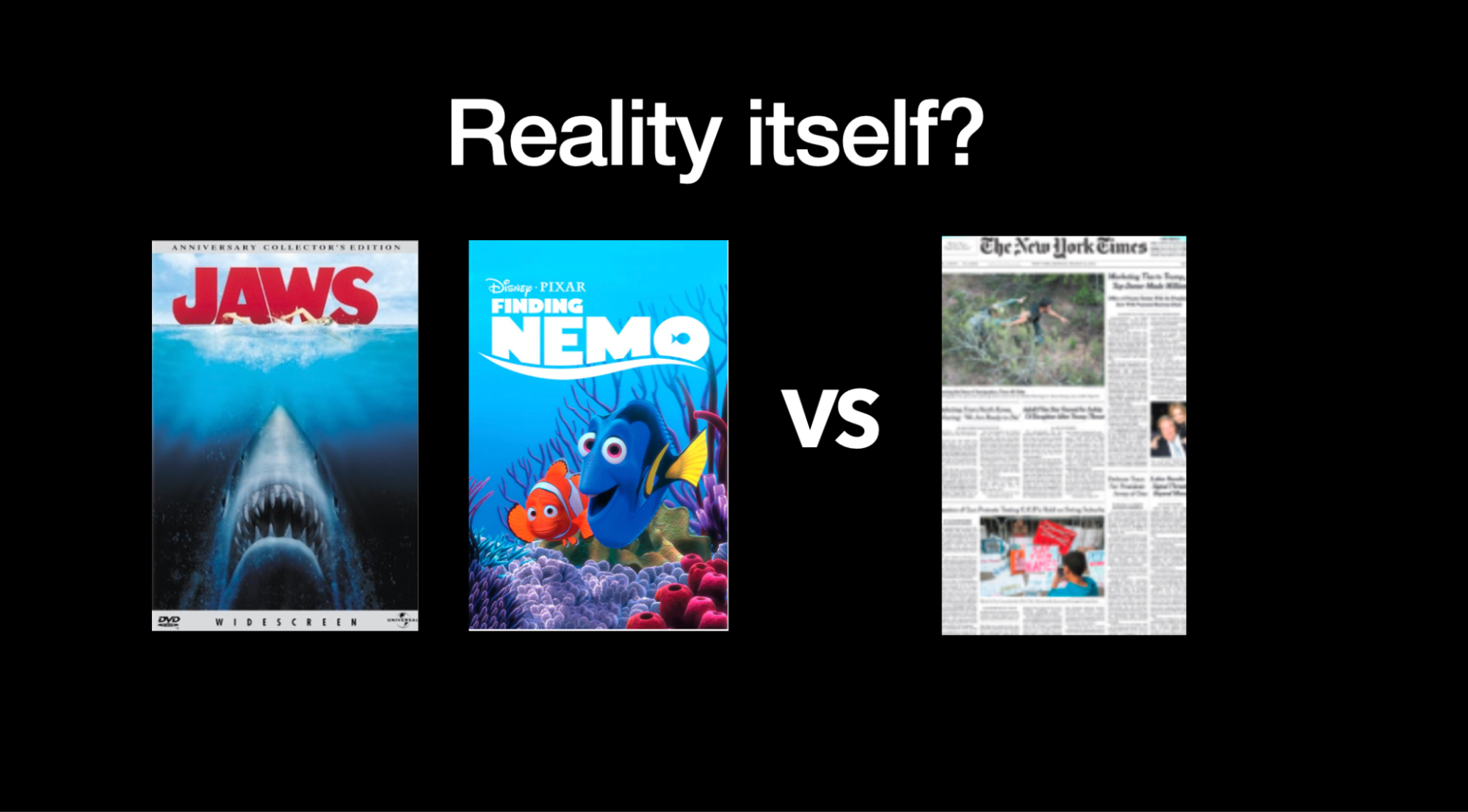
Some aesthetic practices like this might undermine the opportunity to stand out in a serious way and could be seen as trustable. When scrolling down a feed in an 8-second world, this story might look like just one of these campaigns for yet another new movie about sharks.
Where VG hits a wide audience across multiple platforms, NRK P3 is reducing its possibilities to hit wide when they stop using third-party platforms. This might give them issues in recruiting new/younger generations and they might lose market share against other brands. On the other side, we have reasons to believe that NRK P3 is seen as a more trustable brand because they work visionary with branding and ensure that all of their content is designed in a way that underpins NRKs overall design universe. At the same time, by reducing their presence on third-party platforms and being best on their homecourt they are in a position where they do not have to defy their own design manuals or to Disneyify or tabloidize their content by following what’s trending outside traditional journalistic standards.
Today’s younger target groups are having increasingly lower attention spans than the ones three decades ago. Gen Z is the generation that spends the most time on the internet but the least reading the news. They see a lot of content for an hour or a week, therefore they are having extremely high expectations for how things should look like.
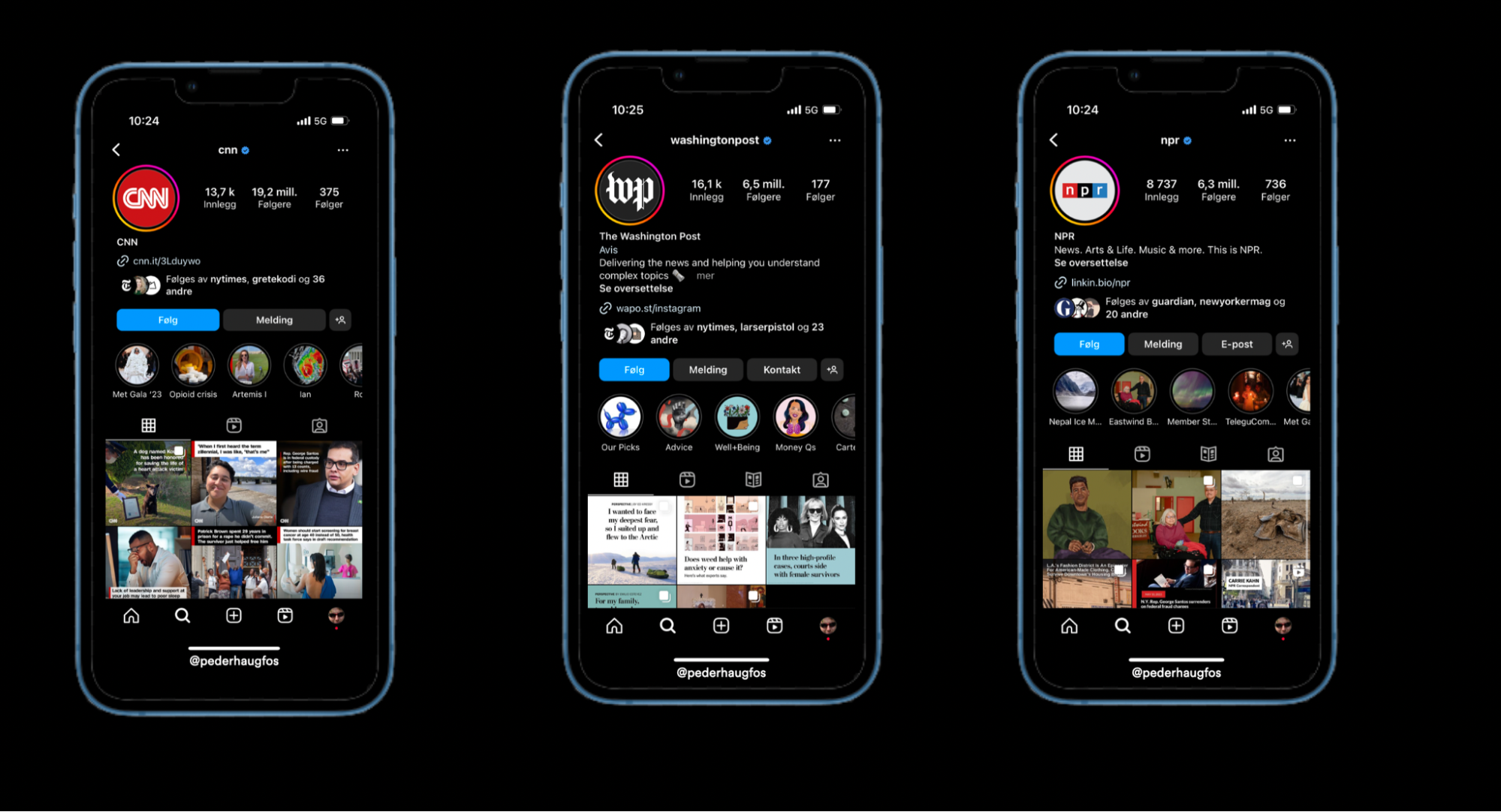
Research states that Generation Z even favors visual-only platforms, like Instagram and Snapchat. This has led to Generation Z’ media consumption choices fueling the growth of visual over verbal, as they e.g., prefer photo-based content over text-heavy articles. If Instagram and Snapchat are now the primary platforms for young people’s news consumption, young media consumers will mostly see content that is no longer medium or publication specific. As mentioned, CNN, The Washington Post, and National Public Radio (NPR) look much more similar today than they did three decades ago. Considering these trends, one can question the tendencies of how legacy media are inspired by traditional marketing and branding strategies in the competition of getting a digital audience. Research on online legacy media has stated that media websites should be edited in terms of brand extensions, and the leading idea here is that the use of the same brand name in different channels represents an attempt to leverage the brand’s equity. Brand equity clarifies itself both indirectly as brand awareness and brand image, and also directly as different consumer behavior.
After working a lot with this research and related topics, my over all question is this:
Why aren’t Broadcasters more disruptive in the way that they try to frame themselves across multiple platforms?
I think some media institutions should shift their focus away from trying to appeal to a broad audience solely based on numbers (likes, revenues, etc) and start prioritizing their passion. By creating communities for specific groups of people who share a common interest or identity, these institutions can connect with their audience on a much deeper and more meaningful level. By building multiple communities, they can eventually create a village, a land, and ultimately unite the entire world of niche, passionate individuals (¯\_(ツ)_/¯)
Conclusion
My tip for you is therefore just this one:
Be disruptive!
Either you boycott or fully leave yourself to third-party platforms, do it in a sexy way. Do not try to look like all your competitors that struggle with reaching out to the exact same people with almost the exact same content. You need to differentiate and why not do that in an aesthetically, disruptive and sexy way?
Invest in great storytellers & visual artists and create content, design profiles, and input in your social media feeds that are attracting GEN Z`s eyeballs instead of looking just like another corporate message.
Article written by Peder Haugfos, NCE Media
Do you find this interesting?
Just send Peder Haugfos a dm on LinkedIn and he’ll be up for further discussions and sharing insights.


