Rewriting a Burning Media Ecosystem

There were a lot of highly recommended and sometimes overhyped sessions at SXSW and you were constantly living in FOMO: Did I pick the right session, or was the other one better? It was often a difficult choice and it is an impossible task to tell you all about SXSW. But we try, and while we’re still living a bit in fear and exhaustion, we want to give you an overview of what SXSW thought of the current media industry, the top trends for 2023 and the biggest predictions of the future. (Spoiler alert: there is no way to predict the future!
One of the sessions that we certainly didn’t doubt about was the session by Evan Shapiro called ‘What The Fuck Happened? The Great Reboot of Media & Tech’. For Shapiro, 2022 was a special kind of fuckedupness and he showed us why with his Media Map. Shapiro is an Emmy and Peabody Award winning producer and CEO and media cartographer at ESHAP. He starts his conversation with stating that “in order to understand what is happening in media, you have to understand the power dynamics between the Trillion Dollar Death Stars with unlimited resources (Apple, Microsoft, Amazon and Alphabet) and the old-guard media players who are trying to redesign the bathroom in a house that is burning down (Disney, Netflix, Warner Brothers)”. A beautiful quote to begin his talk with.
Mapping the future
The Trillion Dollar Death Stars have a disproportionate gravitational pull in the ecosystem since they control the technology that powers the ecosystem. They are therefore the first and foremost driver of change that push the ecosystem in different directions.
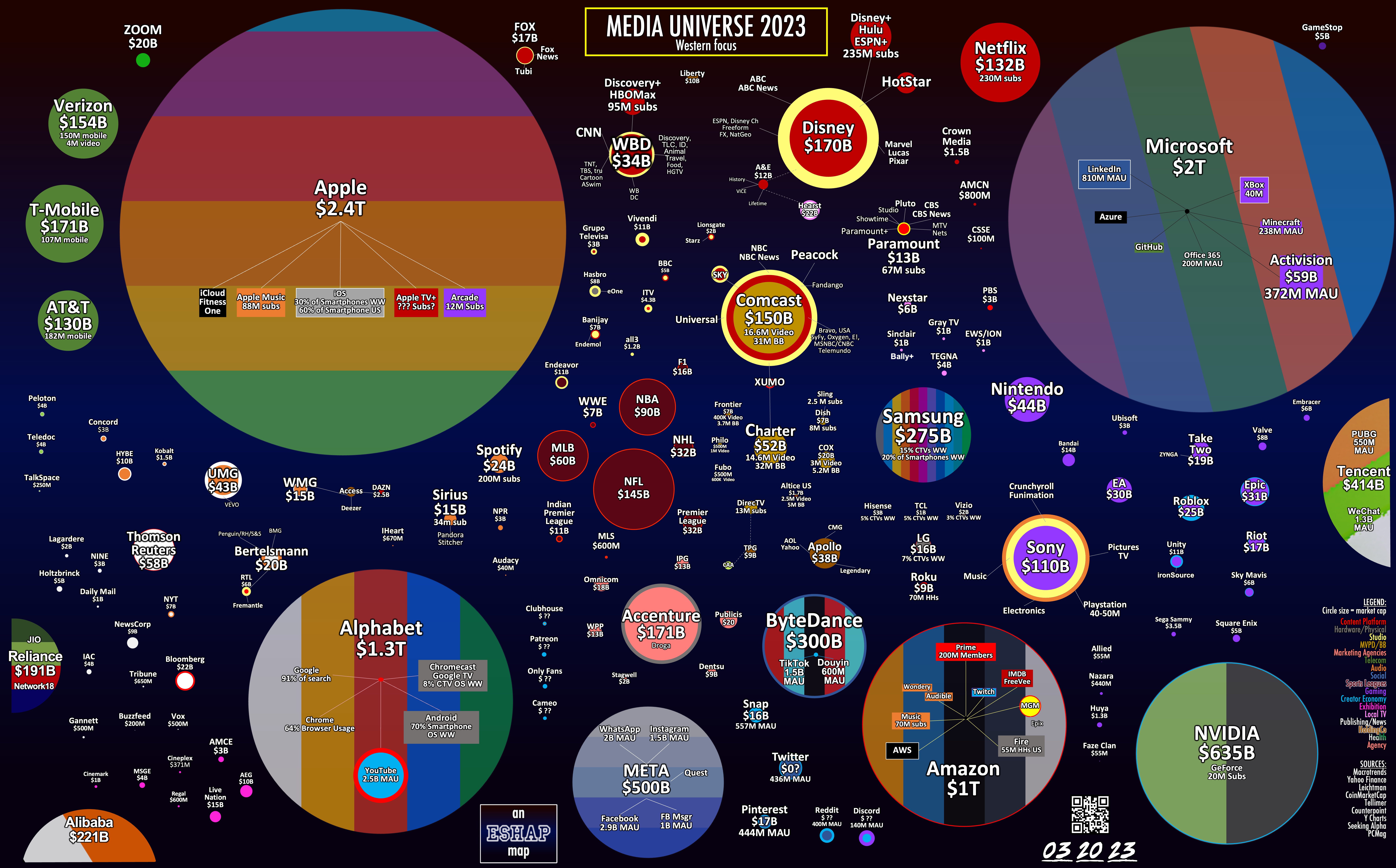
The current state of the industry can further be seen as a bit of chaos. We are reassembling it in real time, while nobody actually knows where to go. First of all we are in a period of economic recession with a lot of lay-offs in the media and tech sector. During the second day of SXSW, on March 10th, the Silicon Valley Bank (SVB) even collapsed after a bank run. But regardless of the current economic situation, Heidi Chung, media analyst at Variety Intelligence Platform, remains optimistic and predicts a boost in the labour market.
Secondly, there is an over supply of content that users can access at any moment, on any device no matter where they are. There are a lot of players in the streaming space and with consumers now having unlimited content to access (anywhere, anytime and on any device), companies are slowly cannibalising each other. Shapiro even states that “serial churning is the new channel changing”, meaning that consumers often only subscribe to a certain platform to binge-watch a series. Once they’ve seen what they wanted, they cancel their subscription and go on to the next one.
Over the past year we’ve also seen a shift in a focus on streaming subscriber growth to focusing on profitability. In that view, the numbers of Variety Intelligence Platform indicate that Netflix is the only profitable company in the streaming world. Streaming companies are simply throwing business models around to find a way to stay (or become) profitable and nobody actually has a clue which way is the way to go. But when we approach the industry from Shapiro’s point of view, then Netflix is actually doing pretty bad. According to him, the winners in the industry are the ones that can find a balance between single unit sales (advertising) and recurring revenue bundles (subscriptions). Having diverse revenue streams and not relying on only one product/service is the key to success and thus to keep customers around. As a media company, you have to give them different options in different areas instead of relying on a one-size-fits-all approach. For example Amazon, where you can order everything you need, but also watch the series and movies you love while having ads or paying a bit more to skip the ads, is doing better than Netflix where you can only watch content or Meta, which is basically a 98% advertising platform according to Shapiro. We have to keep in mind that as long as you present the right content, consumers (and increasingly the younger generations) are more than willing to pay. This balance between advertising and subscriptions is increasingly important and therefore the second driver of change.
The last drivers of change are related to the generational and management shifts. Almost half of the working environment consists already of millennials and Gen Z and by 2030, it will be closer to 80% and Gen Alpha will be joining the workers. You can no longer see them just as consumers but we have to look at them as decision makers in the industry. This generational shift is also happening in consumption and the future of social media will look a lot more like Roblox and Fortnite. For Gen Z, it is all about being part of a community and Sofie Hvitved told us about a metaverse report that states that “52% of Gen Z feels more like themselves in the digital environment than in the physical world”. In our previous article on games and the metaverse, we even quoted Paul Bettner who said “games are the new schoolyards”. You can read up on the importance of social presence and the other game insights in ‘All things Metaverse at SXSW’.
And the future holds
Now that we’ve discussed the current state of the media, we can talk about what lies ahead for the industry. How could we not, with so many futurists together in one place? The two biggest stars of the town were Amy Webb (remember her 2023 Emerging Tech Trend Report?) and Sofie Hvitved (metaverse specialist). Both try to help organisations to solve their strategic and business challenges by thinking about the long term possibilities to drive innovation and change. Being a futurist is all about anticipating possible futures rather than predicting the future. There is not one definite future that will happen regardless of other circumstances. Instead, there are multiple options of possible futures and we have to be prepared for them all.
“There is no future, there are only possible scenarios for the future.”
Sofie Hvitved, Futurist and Head of Media at the Copenhagen Institute for Future Studies
In the middle of tectonic changes in the media industry, a couple of trends can be spotted. We’ve already talked about the fact that the world will soon be dominated by millennials, Gen Z and Gen Alpha and that Roblox, Fortnite and Minecraft will be the new entertainment platforms. We also know that serial churning is the new channel changing and that companies that balance subscriptions well with ads will be the future winners. In the first article (SXSW Revelations of Generative AI) we saw that Amy Webb thinks the great AISMOSIS is coming and generalist AIs will be the new norm. “AI will be a tool, just like the phone in your pocket”, but we have to be aware about a possible new digital divide where people who don’t have access to AI tools will be left behind. And in this ever evolving world, “transparency is the new objectivity”.
One of the trends that we did not discuss yet (but should do so right now), is the identity crisis of journalists. On the one hand, journalists talk about the facts and figures and try to stay neutral when reporting. But how do they deal with and write about the constant stream of future predictions, where facts are not always that easy to find? It is no longer possible for journalists to not talk about it, but it’s also counterintuitive to do so. Journalism should move towards a more empirical kind of work where they rely more on foresight methods rather than extrapolating or making false predictions as they sometimes can do. For example, when the Minneapolis bridge collapsed, papers mostly talked about how they'd warned the Minneappolees that it would happen. Sounds to us like they were just adding some fuel to the fire… Nevertheless, uncertainty will always be a part of their job, but making that uncertainty transparent can be a way to make journalism more open, honest and successful in the future.
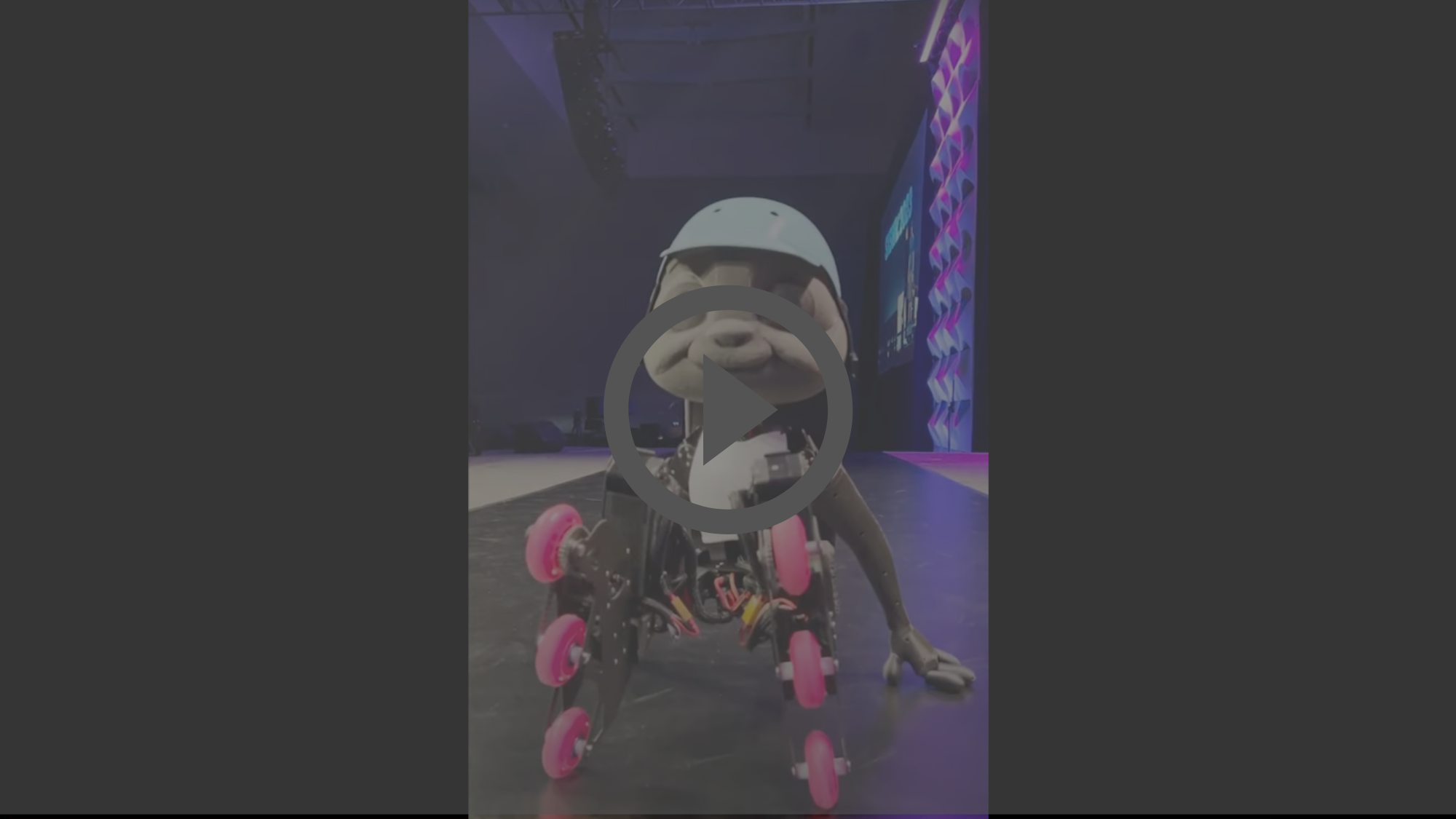
The last trend that we should definitely address is content and storytelling. While we have a whole new article waiting for you on that topic, let us just dip our toes into the most promising future ideas. First of all, we have to talk about Disney, I mean did you see that cute robot they showed off? At the core of every single Disney experience is happiness and they try to achieve happiness by immersing their guests completely into the story. (Stay tuned for next week, when we tell you all about how they do it) One of the things to make a story as immersive as possible, is to make the characters real because the more that they feel real, the deeper the connection you have with it. Right now, Disney is using robotics to create a physical version of their on-screen characters, for example the bunny Judy Hopps from Zootopia. While you can rewatch it on YouTube, experiencing the live stunts of Judy Hopps was amazing and actually did make us very happy.
A lot of different things are thus happening in the media ecosystem. We’ve touched upon the current state and some future possibilities that we thought are the most important from SXSW (the generational shift, subscription churnings, AI and transparency, games and content), but there are so many more. We can write numerous pages about upcoming trends and once we’re done, we can start rewriting because the ecosystem will have drastically changed once again. We are currently reshaping the media ecosystem and in this transitioning world, futurists and trend watchers are ever important.


