The Future of Audio: A Slush event

On November 17th, 2022, Future Media Hubs combined forces with Flanders Investment & Trade, Yle, Storytek and The Exit Academy, and organized a Slush side event on Audio. Slush, the world's leading startup event, aims to connect founders to build a new, inclusive and more purposeful culture of entrepreneurship.
During #futureofaudio, we took a look at the state of the industry. What are some exciting new technologies and what are the possibilities for the European audio landscape? After reading this article, you will be fully updated on what lies ahead for sound-driven content. Going from startup pitchings, a keynote by Aura Lindeberg from Yle and a panel conversation, to a networking opportunity with waffles (something we, sadly, cannot recap), Slush, once again, was an inspiring day full of new information.
The startups
BotTalk (Germany) is a speech generator that sounds so appealing and human, that you can’t tell the difference between the AI and a real person. BotTalk converts over 100 000 articles into lifelike-sounding speech every day. By using supervised machine learning, BotTalk finds and corrects errors in those articles, making the AI sound more natural.
a.i.mater (Finland) is a software company focusing on natural language processing (NLP) that helps other companies communicate with people by using speech synthesis, speech recognition and other tailored NLP tools. The STT solution can automatically transcribe meetings or interviews and create voice user interfaces for apps.
Audio is shifting its paradigm from linear to on-demand content, which explains the current podcast boom. Voxalyze (Germany) helps companies with visibility analytics within the wild world of listening platforms. They also provide audience analytics and campaign attribution for listener acquisition campaigns happening outside the listening platforms, for example on social media. This can help companies with answering questions like “Where should we invest more in the promotion of our show?” or “How does our show rank in a given search query?”
Rumble Studio (France) identified some of the pitfalls of podcasting and came up with a potential answer. Podcasting is a slow and expensive process. It takes about 10 hours to make an episode, and with the overload of steps and tools, most new podcasters quit after seven episodes on average. Rumble Studio created a simple and scalable system in which podcasts can be recorded asynchronously. By providing a.i. generated follow-ups and coaching, the conversations last longer and the spontaneity is increased.
IZI Record (Spain) allows broadcasters to increase their audiences’ engagement through the combination of their broadcast signal with videos created by users in real-time during an event. This is made possible by a simplified 3-click recording-editing-and-sharing process powered by deep learning technology. This new tool transforms video-based content creation in a social experience. The outcome is a personalised video enhanced with other video sources and auto-edited right at the moment. Users can enhance their videos thanks to the premium content generated by the broadcaster and the broadcaster will be able to use the users’ generated content.
The potential of audio at a public broadcasting company
Aura Lindeberg is an audio media expert and researcher with over ten years of experience developing radio and audio content and distribution. At the Finnish Public Broadcasting Company Yle, she works as a publishing executive and team leader, finding new ways to use audio in changing media environments. With about 75% of Finns listening to the radio on an average day, it isn’t going anywhere. However, the way the audience approaches audio is undeniably changing. Yle identified three of their main questions:
- Are radio and podcasts offering audiences the same thing?
- How important is your own platform? How much content should you distribute on other platforms?
- How do you reach younger audiences?
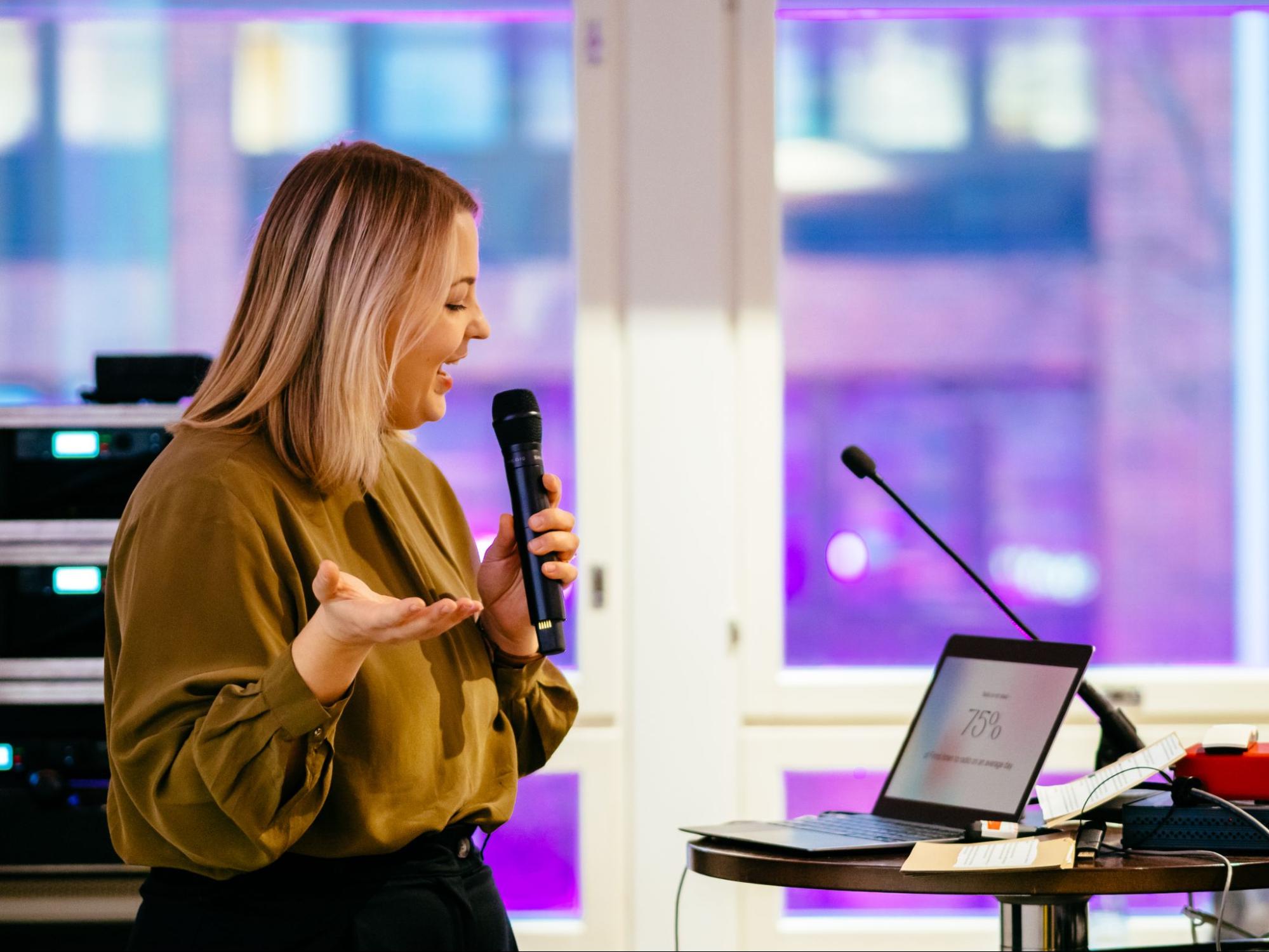
Big changes are coming to everyone in the audio business. Even traditional, and somewhat “stable” institutions, ask themselves what to do, and if they have the right tools to be innovative enough.
The ongoing shift in the listening culture is also creating a lot of opportunities. The most important thing to currently notice is that you can listen to things even when your eyes are occupied and still have a strong, powerful experience. There is a growing variety of audio media. We all know radio, podcasts and audiobooks, but the way people use all types of media is evolving. People interested in that change should pay attention to how people mix and merge their habitual media use, like for example just listening to a video without watching it.
Aura states that, in terms of development, the European audio market is about seven years behind the one in the United States. Luckily, things are speeding up. In Sweden, close to 400 000 households pay for podcasts. That’s more than twice as many as in 2021, which inevitably brings us to Spotify. The Swedish audio streaming platform undeniably rules the European market with over 443 million worldwide listeners. According to a study by the European Broadcast Union, over half of the European public radio broadcasters think that Spotify is either an important strategic platform or that at least it requires their active presence.
Recently, Spotify announced that it is expanding into video podcasting in 180 markets. This puts the company in closer competition with YouTube, where video podcasts have been growing in popularity. Spotify has been heavily focusing on podcasting, video and non-video alike, after spending more than $1 billion on podcast-related acquisitions. Knowing that the European audio market is changing rapidly the question arises: what is the role of public service?
In the Nordic digital audio market, public service media has had a major impact in creating an infrastructure for listening, as well as teaching many people how to listen to podcasts by being the first to experiment in this field. But what is also important is that public service media trains new talent, who later might work for commercial media outlets as well. The value of public service media in the larger field of media is its role to experiment with things that are not profitable yet.
What comes next?
This is a question that requires input from many directions, because the field of audio needs more exploration in general. It is also an urgent question because to remain relevant, all media houses have to change their use of media and content. Besides that, the expectations the audience has for their platforms are high and a public service company doesn’t have the same type of budget as a company like, for example, Netflix.
According to Aura, the way public service broadcasters approach audio needs to be more innovative. Because of the legacy of these companies, that tends to take some time. But when they finally do change, it often disrupts the whole industry. Because of the long tradition of content development, public service broadcasters are really good at innovating. This can be done by breaking barriers between public service broadcasters, commercial companies and startups. Aura encourages everyone to discuss our successes, failures and experiments. Because this is how we will come up with solutions to enable structural change.
Industry insiders
Next up, Aura joined a panel conversation between industry experts. Together with Jakob Munck, the CEO & Founder of Munck Studios, Turo Pekari, a music industry executive, innovation specialist and community builder based in Helsinki and Sam Bailey, who spent 14 years at the BBC, including roles as a Commissioning Executive at BBC Radio 1, Editor of BBC iPlayer, and Exec Producer for digital coverage of music festivals, before leaving in 2018 to become the Managing Director of The Radio Academy, the foursome discussed the state of the industry. Sten Saluveer, a Japan based audiovisual media innovation and policy strategist, audiovisual producer, content & technology entrepreneur andCEO at Storytek Venture & Innovation Studio, moderated the conversation.
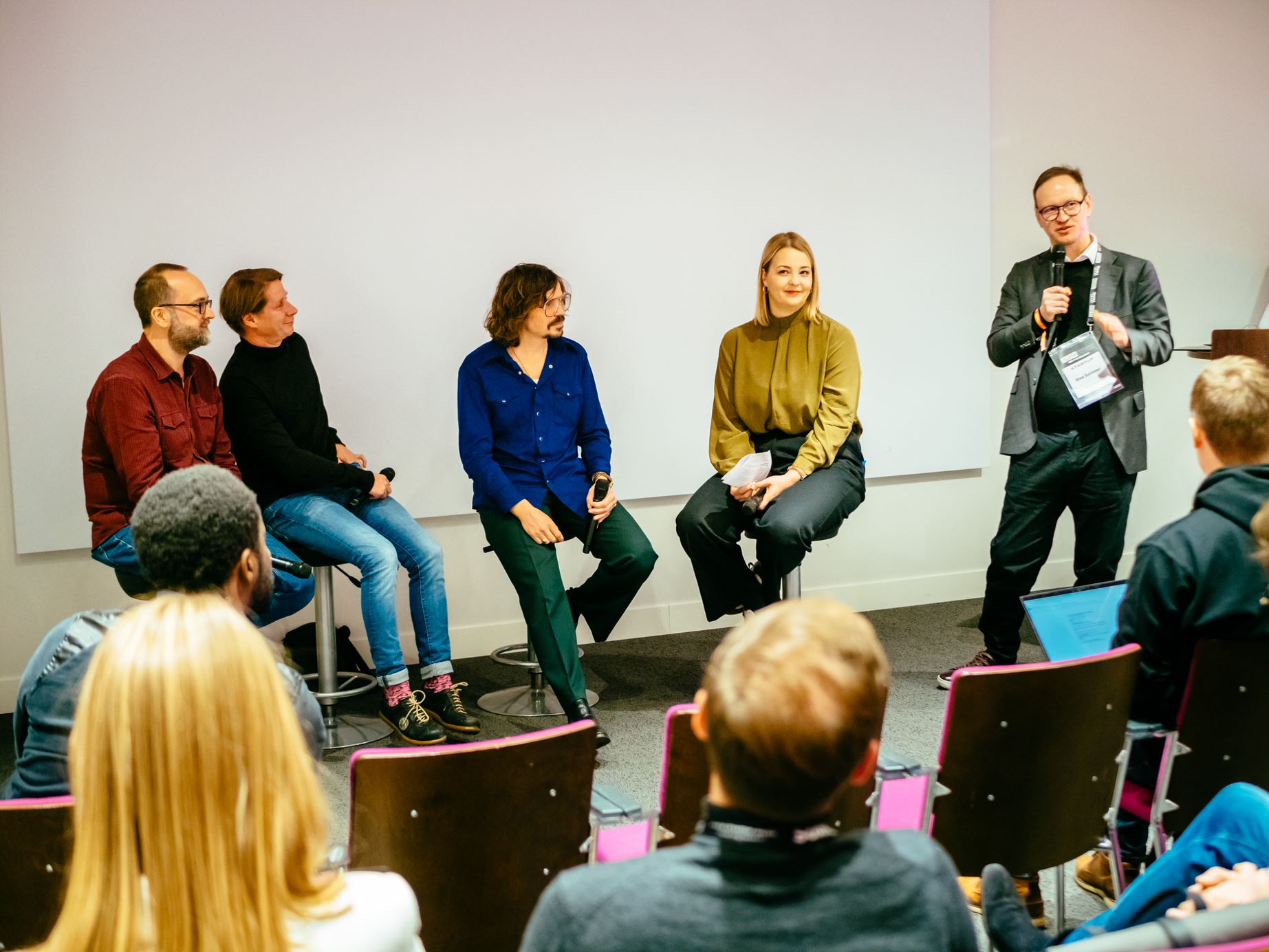
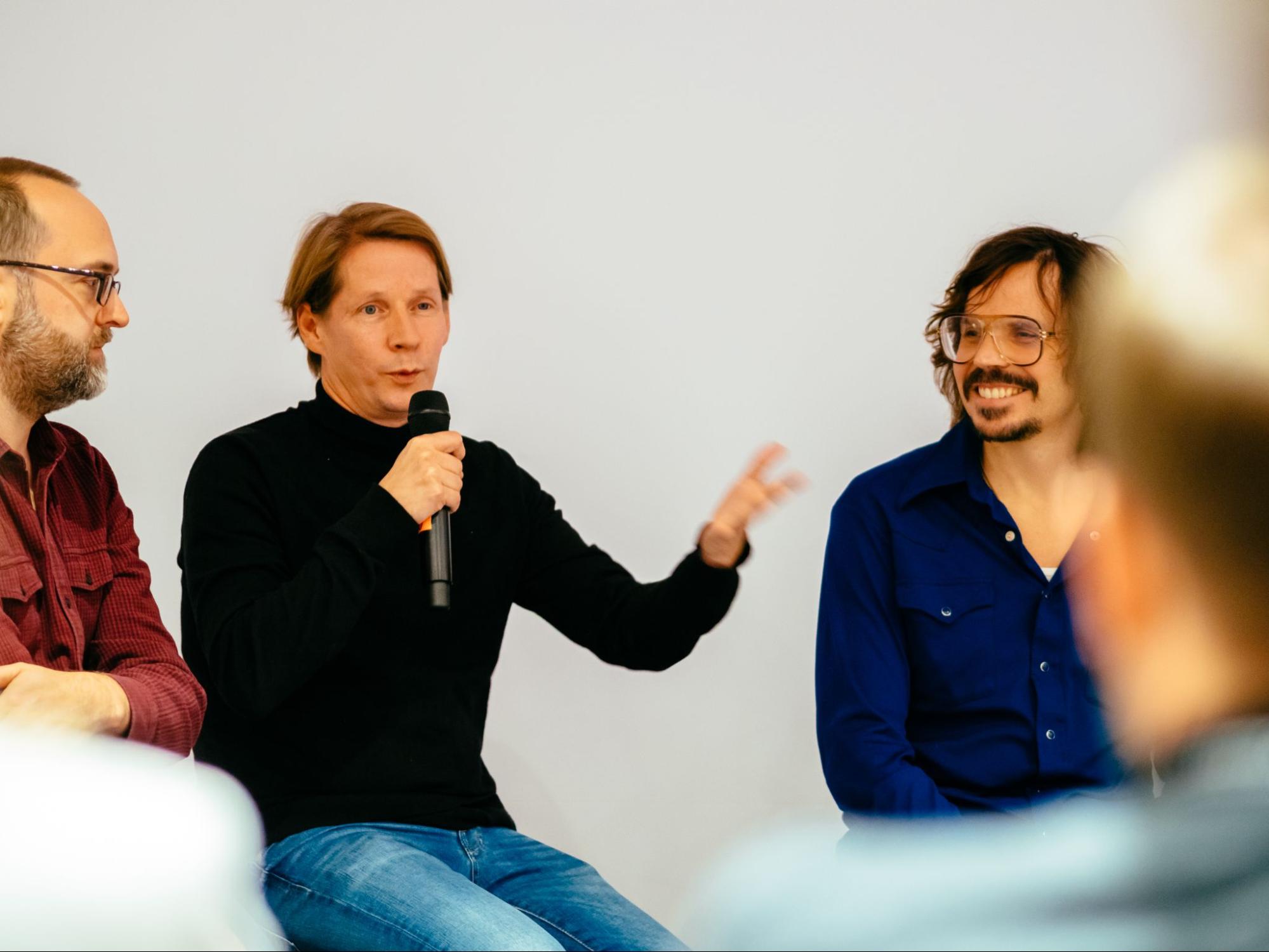
The audio space is expanding rapidly, with people consuming about seven hours of media a day and platforms growing fast. In the UK, radio still drives the biggest market share, but this ranges massively across age groups. Sam Bailey has worked in youth media at the BBC and thinks that the growth area around creativity is probably not in linear audio. When it comes to music consumption in digital services, we are already near the saturation point, according to Turo. Services like Spotify are competing against broadcasters. In a sense, everyone is competing for the time of the consumer, who has a wide variety of different digital services.
On the production side, the biggest trend has to be intellectual property (IP) in audio. In recent years, numerous shows which were originally commissioned by the BBC have moved to commercial platforms. Many audio indies are launching their own Originals. Several podcasts have been spun off into TV shows or live productions. Some elements contribute to a successful podcast: the manuscript, the concept, the underlying material and the soundediting. Sometimes, even one of those things can travel internationally. By localizing it to a specific audience, there are a lot of opportunities to create a bigger market for your IP.
However, the business model is still lacking. There isn’t a lot of money going to creators of audio content. This is an area in which the industry can improve. Coming from the public broadcaster side, Aura wonders if the big platforms are a public broadcaster's threats or friends.
So where exactly lies the problem in the creator monetization theme? Is it the size of the market? Is it the fragmentation or the lack of underlying standardization or infrastructure? In Europe, there is no standardization in the audio industry. When it comes to Spotify, podcast creators see nothing from the revenue the platform generates from people listening to their work. For the creator, money has to be made somewhere else, like with brand partnerships, live shows, merchandising or from YouTube.
Compared to the music industry, for example, podcasts are not considered a work of art. In that sense, they don’t have a copyright status. Here lies the difference with a public service broadcaster, which pays for its creators. The role of public service is also to foster and grow new talent. Aura considers it an important role to build bigger personalities in podcasting.
But there is a marketing issue as well. Some genres, like true crime, are hard to monetize. According to Sam, the problem with monetizing a podcast is the same problem the web has in general. Podcasting was built on a regular platform on RSS, and the culture was built around it. Only for about the last five years, people have been working with subscriber models. Consumers are trained to want their content for free. But monetizing advertisements isn’t the answer either. The one thing that makes podcasts so special and radical, their authenticity, is being threatened when you feel like you are listening to a sponsored conversation. Besides, it’s also really easy to skip the ads.
Is synthetic audio a danger or an opportunity?
When it comes to more technically innovative products, like text-to-speech, the industry is also trying to figure out how money is made. A huge task, because the copyright debate around Web 3 and the Metaverse is still a jungle. However, people are trying to come up with some first ideas on how to compensate performers, artists or writers. IP rights management is an interesting topic at the moment, and there are a lot of companies developing tools to handle that. Besides that, voice search is also going to drastically change the way we consume and discover new content in the future.
There is this common fear that in the future, AI will “replace” humans and do everything for us. Luckily, you always have to have an original. The much-discussed ABBA avatars, for example. If you don’t have a relationship with these people, would you go to that concert? It is interesting to see what technology is going to be able to do for the music industry. What will happen as publishing rights and back catalogs get sold as these artists die, is that you may be able to go and see the Rolling Stones in 50 years. What will that do to the new music landscape when people spend their money on historical acts?
Predictions
Sten rounded up the half-hour conversation by asking the panelists about their predictions for the future. Turo thinks that we will soon find new ways to license our content and royalty payments. He is confident that there are enough technological possibilities for companies that are developing those services. Jakob thinks that quality will rapidly increase. This applies to the sound quality, but also the content. That is why he is excited about the possibilities of scripted shows. Aura is fascinated by the battle of the platforms. Who will dictate where we listen to podcasts? Is the podcast market too saturated, or will it get too saturated? Besides that, audio is not only competing with audio. It is competing with general media use. Sam thinks another trend over the next few years is gonna be more cutting of subscriptions. Because of the recessions that are coming, people want things bundled in together. The other thing is going to be the battle for the car dashboard. According to him, linear radio lives and dies by being present on dashboards. A huge focus of the UK sector at the moment is making sure that even delivered in a non-linear way, radio is always present in the car.
Conclusion
Voices are not going anywhere. People love good audio storytelling, and that is going to stay. The way we listen to it, however, is changing. Keep an eye on the way consumers mix their media use, like, for example, the shift to video podcasting. Besides that, there are also a lot of monetization opportunities that can make creators less dependent on the gatekeepers of the platform. There is currently a lot of potential in creating a bigger market for an IP.
As a public service broadcaster, it is always important to remember that your role in the media landscape is to be a driver for change and a catalyst for new markets. However, legacy companies can be slowed down by their bureaucracy. That is why these broadcasters should work together, share and experiment with audio businesses, instead of competing with each other.


